Free delivery on orders over €150


Black truffle vs. white truffle: differences, seasons, prices

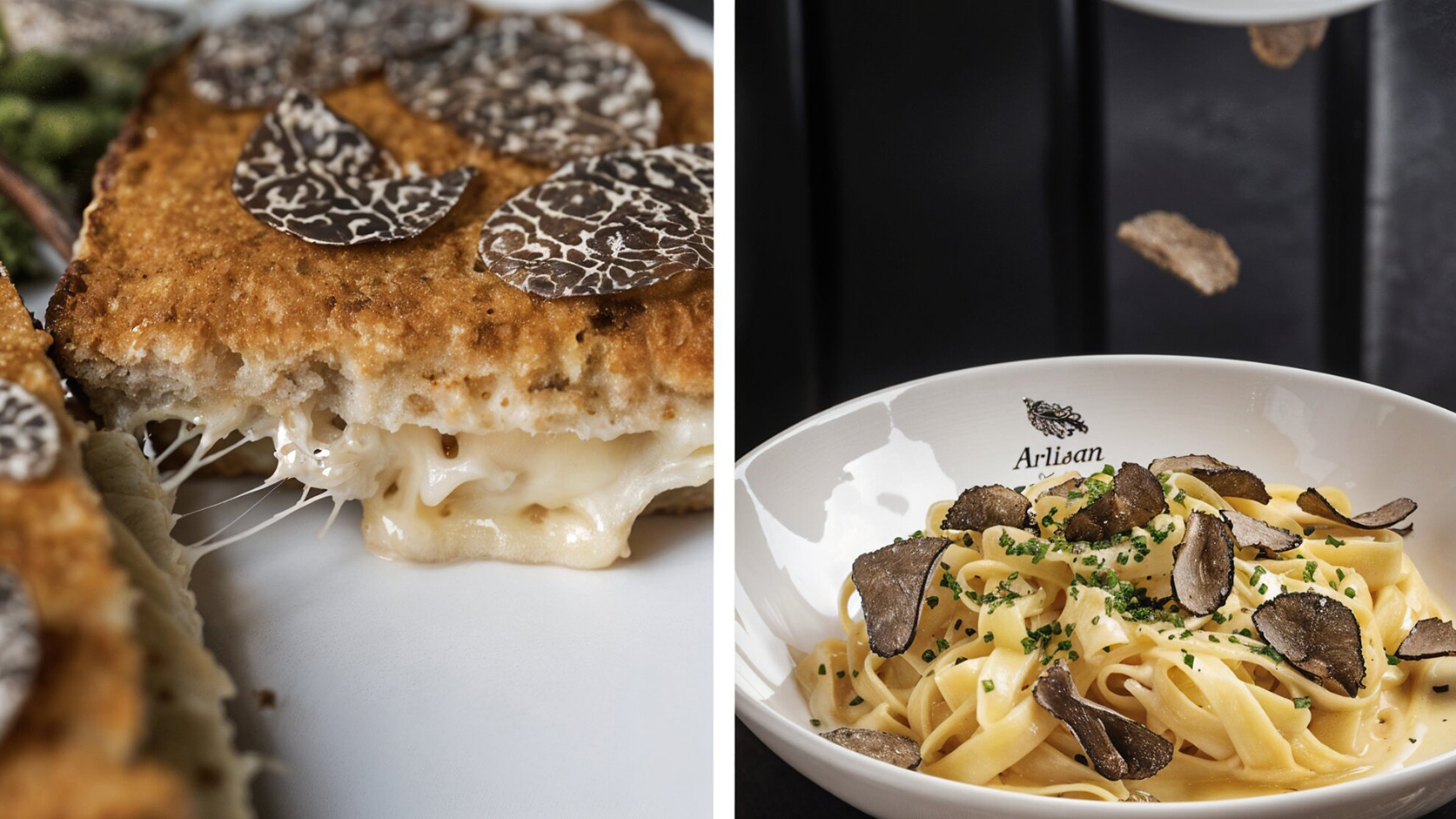
The black truffle evokes the Périgord, winter, and the market in Richerenches on a Saturday morning in January. The white truffle is Alba, autumn in Piedmont, auctions where a kilo can fetch €5,000. Two underground mushrooms, two worlds—and a common confusion among those new to truffles.
Here’s what really sets them apart, beyond their skin color.
The quick verdict
Choose the black truffle if You’ll want to cook with it. It holds up well to heat and works well in sauces, risottos, and scrambled eggs. Its aroma intensifies as it cooks. It’s the chef’s truffle.
Choose the white truffle if You want it raw, unprocessed, and fresh. It’s grated over a hot dish at the last minute and is never cooked. Its aroma is so intense that just a few grams are enough to transform a dish. It’s the truffle of fine dining.
What exactly sets them apart?
The species
These aren't two colors of the same mushroom. They are two distinct species.
The black truffle — Tuber melanosporum — grows in symbiosis with oak and hazelnut trees in the limestone soils of southern France, Spain, Italy, and Australia. It is also known as the «Périgord truffle,» although the best ones often come from Provence or Tricastin.
The white truffle — Tuber magnatum Pico — grows exclusively in a few regions of Italy (Piedmont, mainly around Alba) and in certain areas of Croatia and Istria. No one has ever succeeded in cultivating it. Every white truffle is wild, found by a dog in the woods, often at the base of an oak, a linden, or a willow tree.
It is this inability to cultivate them that explains the price difference between the two. The black truffle, on the other hand, can be cultivated—trees are planted with mycorrhizae (inoculated with the fungus), and it takes 5 to 10 years before the first harvest. It’s not industrial agriculture, but it is agriculture.
Appearance
The black truffle has a rough, bumpy skin that is deep black. When cut in half, its flesh (gleba) is dark brown to black, crisscrossed by fine white veins that form a dense network. The closer together the veins are, the riper the truffle.
The white truffle has a smooth skin, ranging in color from cream to ochre, and sometimes with a slight pinkish tint. Its flesh is marbled with light veins against a beige-pink background. It is often more irregular and misshapen—it is a wild mushroom, after all, not a standardized product.
Fragrance—that’s where it all comes down to
The most striking difference is the smell.
The black truffle smells of damp earth and the forest floor after rain, with notes of cocoa, musk, and toasted hazelnut. Its aroma is powerful yet subtle. You have to put your nose in the box or cut the truffle open to fully appreciate it. And it reveals itself even more when heated—that’s why black truffles are cooked.
The white truffle is a whole different story. Open the bag and the whole room knows it. Its aroma is explosive, almost animalistic—fermented garlic, honey, aged cheese, earth—with an intensity that surprises every time, even when you’re familiar with it. It’s a scent unlike anything else in the culinary world. And unlike the black truffle, it doesn’t hold up to cooking. Heat destroys it in a matter of minutes. That’s why it’s always grated raw, at the very last moment, over the hot dish.
The Seasons: When to Buy Which Truffle?
This is something many people don’t realize: truffles are seasonal products. Not in the marketing sense of the word—but in the biological sense. You can’t find fresh truffles out of season. There are canned truffles, truffle oils, and prepared truffle products, but fresh truffles follow nature’s calendar.
Black truffle (Tuber melanosporum) — From mid-November to late March. The peak season is in January and February, when the nights are coldest. This is when the aroma is at its strongest and prices drop slightly from the December surge (due to the holiday season). Connoisseurs buy in January.
White truffle from Alba (Tuber magnatum) — From late September to late December. The season is short—three months, sometimes less, depending on weather conditions. It peaks in November. After Christmas, the season is over.
Summer truffle (Tuber aestivum) — From May to August. Less fragrant than its winter counterparts, but affordable and widely used in processed foods: truffle oils, sauces, pasta. The Summer truffle from Maison de la Truffe is available on the website during the season.
Burgundy truffle (Tuber uncinatum) — From September to December. A good compromise between the summer truffle and the melanosporum: more fragrant than the summer truffle, less expensive than the black Périgord truffle. The Fresh Burgundy truffle is available in season.
| Black truffle | White truffle | Summer truffle | Burgundy Truffle | |
|---|---|---|---|---|
| Latin name | T. melanosporum | T. magnatum | T. aestivum | T. uncinatum |
| Season | Nov — Mar | Sept. — Dec. | May–August | Sept. — Dec. |
| Peak maturity | January–February | November | June–July | Oct–Nov |
The price: why such a difference?
Let's talk numbers, because that's the question everyone is asking but doesn't dare to voice.
Black Périgord truffle — Between €500 and €1,200 per kilo fresh, depending on the season and quality. In December, prices rise (due to Christmas demand). In January and February, they drop again—paradoxically, this is when the truffles are at their best. An «extra» (a whole, round, fully ripe truffle) costs more than a «first choice» or pieces.
For home use, expect to pay €50 to €80 for a piece weighing 30 to 50 grams—enough to flavor 4 to 6 servings of risotto or an omelet.
White truffle from Alba — Between €2,000 and €7,000 per kilo. Yes, up to €7,000. Exceptional lots sold at auction in Alba sometimes exceed €10,000. The explanation can be summed up in two words: wild and rare. It isn’t cultivated; the quantities harvested each year depend entirely on the climate, and global demand continues to rise.
For home use, 10 to 15 grams is enough for a pasta dish for two—which comes to €30 to €70. It’s expensive, but it’s not out of reach.
Summer truffle — Between €150 and €400 per kilo. This is the entry-level fresh truffle, and it has its own unique qualities—a milder aroma and a firm texture that works well in carpaccio.
Year-round alternatives. During the off-season, the canned truffles — whole, in shards, in mashed potatoes or in juice — allow you to experience the flavor of black truffles. For white truffles, the white truffle purée and the seasoning powder are the best substitutes.
How can you use them in cooking?
This is where the practical distinction between the two becomes clear.
Black truffles in the kitchen
She loves the heat. She even craves it. A Melanosporum black truffle sliced into thin strips and tucked under the skin of a capon 24 hours before cooking—it is one of the most extraordinary dishes in French cuisine. The truffle infuses its flavor into the meat overnight, and cooking brings out aromas that were not present when it was raw.
Classic favorites: truffle omelet (the truffle is beaten into the eggs 2 hours beforehand), the Périgueux sauce on a beef fillet, the truffle risotto, truffle mashed potatoes. In each case, the truffle is added during or just before the end of cooking—never at the beginning, when prolonged heat would eventually cause it to lose its flavor.
Fats are its best friends. Butter, cream, egg yolk, olive oil—the black truffle releases its aromas when combined with fat. A truffle butter on a piece of hot meat—it’s simple and it’s perfect.
To grate them finely, a truffle slicer makes all the difference—the slices are even, thin, and melt on the hot plate.
White truffles are not meant to be cooked
Never. No cooking at all. The aroma of white truffles is made up of volatile molecules that evaporate at the slightest heat. Five minutes in a pan and there’s nothing left.
The method: Grate it at the very last moment, using a fine mandoline, directly onto the serving plate. The dish underneath should be hot—it’s the steam rising from the dish that releases the aromas. But the truffle itself remains raw.
Dishes that really showcase it: fresh pasta with butter and Parmesan (the tajarin Piedmontese wines are the perfect pairing), a creamy risotto, a fried egg with brown butter, veal carpaccio. Always simple, understated dishes that let the truffle shine.
Outside of the season, white truffle products allow you to enjoy some of these flavors: the’white truffle olive oil, the white truffle honey, or the roasted hazelnuts with white truffle flavor as an appetizer.
Conservation: Same Rules, Different Urgency
Both truffles should be stored in the refrigerator, at a temperature between 2 and 4 °C, individually wrapped in paper towels and placed in an airtight jar. Change the paper towels every day—truffles release moisture, which accelerates spoilage.
Fresh black truffles will keep for 8 to 10 days if stored properly. White truffles are more delicate—they’ll last 5 to 7 days at most, and their aroma fades with each passing day. The sooner you eat them, the better.
Here’s a tip chefs use: place the truffle and eggs in an airtight jar and refrigerate for 48 hours. Eggshells are porous—the eggs absorb the aroma. You get truffle-infused scrambled eggs without touching the truffle itself. It works with both varieties, but the result with white truffles is spectacular.
The complete comparison chart
| Criteria | Black truffle (Melanosporum) | White truffle (Magnatum) |
|---|---|---|
| Exterior appearance | Black, rough, bumpy | Ochre cream, smooth, uneven |
| Flesh | Dark brown, with tight white veins | Pinkish beige with light marbled veins |
| Perfume | Undergrowth, cocoa, hazelnut, musk | Garlic, honey, cheese, very intense |
| Aromatic intensity | Strong, develops during cooking | Explosive, disappears during cooking |
| Cooking | Yes — simmered, steeped, sautéed | No — always raw, freshly grated |
| Season | November through March | September through December |
| Main source | France, Spain, Italy, Australia | Piedmont (Italy), Istria |
| Possible crops | Yes (mycorrhizal trees) | No (only wild) |
| Price per pound (fresh) | €500–€1,200 | €2,000–€7,000 |
| Storage (fresh) | 8–10 days | 5–7 days |
Where should I start?
If you’ve never cooked with fresh truffles before, the black truffle is the natural place to start. It’s forgiving of mistakes, easy to measure out, and works well in recipes you’re already familiar with. The Melanosporum black truffle is available during the season (November through March), and the Complete truffle service — brush, mandoline, box — everything you need to get started.
If you’re already familiar with black truffles and want to try white truffles, plan to buy them in October or November. Just a few grams will do. A plate of fresh pasta, some butter, and Parmesan cheese—and the truffle does the rest.
And to enjoy the taste of truffles all year round, without waiting for the season, explore the Maison de la Truffe Collection : oils, sauces, condiments, truffle-flavored pastas, and gift boxes for enthusiasts.

