Free delivery on orders over €150


The best caviar and champagne pairings

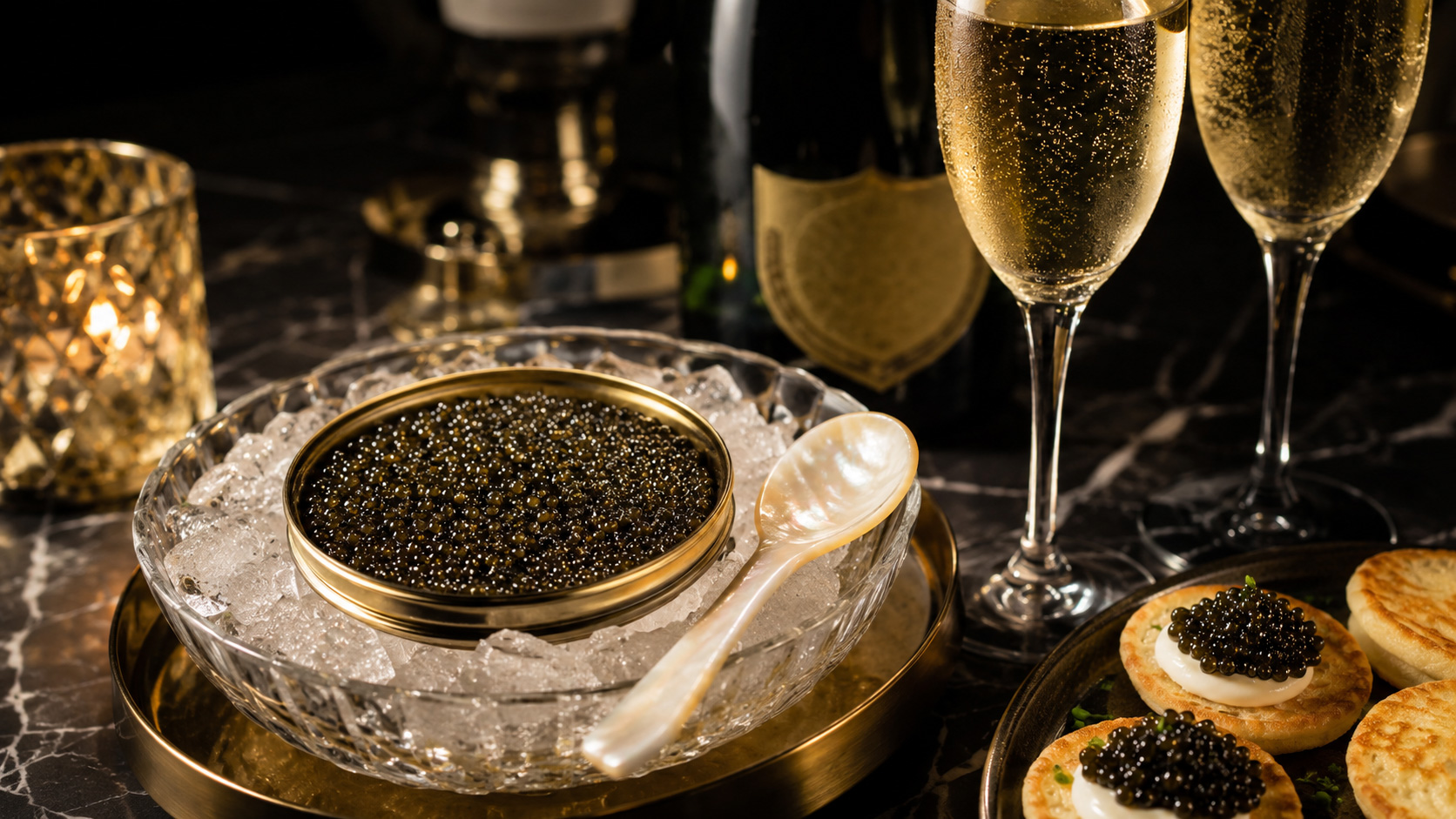
Brut, extra-brut, blanc de blancs—no rosé, no demi-sec, no lukewarm party champagne served in a plastic cup. Caviar calls for a specific champagne, and when the pairing works, both are transformed. The champagne cleanses the palate. Caviar lingers. And between each bite, the palate resets, ready for the next.
This guide tells you exactly which champagne to open depending on the caviar you’re serving—and why some pairings work while others fall flat.
The Chord Chart
| Caviar | Champagne style | Why it works |
|---|---|---|
| Baeri | Classic brut, Brut Prestige | The crispness of the brut highlights the briny notes without overpowering the sweetness of the Baeri |
| Imperial Baeri | Brut or extra brut | The Extra Brut preserves the longer-lasting aromas of the Imperial |
| Osciètre Selection | Blanc de Blancs | The minerality of the Chardonnay enhances the nutty notes of the Osciètre |
| Royal Osciètre | Vintage Blanc de Blancs, Kaspia Champagne Flower | A champagne with character for a caviar with character |
| Royal Beluga | Extra-brut or brut nature | The minimal seasoning allows the Beluga's natural sweetness to shine through |
| Iranian Beluga | Blanc de Blancs Grand Cru | The summit calls for the summit — a Grand Cru from the Côte des Blancs |
Why champagne goes well with caviar
The pairing of caviar and champagne isn’t just a magazine cliché. It’s chemistry.
Caviar is rich. Sturgeon roe contains between 15 and 18 percent fat—it is this richness that gives it its creamy texture and lingering finish. The problem with such a rich food is that it can be overwhelming. After two or three bites, the palate becomes coated with a greasy film and the flavors fade.
Champagne solves this problem in two ways. The wine’s natural acidity (champagne is one of the most acidic wines in existence) cuts through the fat and resets the palate. And the bubbles—the effervescence—act as a mechanical cleanser, lifting the greasy film and freeing the taste buds for the next bite.
That’s why this pairing works every time. Not out of tradition, not out of snobbery—but because of the physical chemistry. The bubbles cleanse the palate, the acidity cuts through, and the caviar can once again express itself fully.
Brut champagne: a safe bet
If you're not sure what to choose, go for a brut. It's the champagne that pairs well with all types of caviar, from Baeri at Beluga Reserve.
The brut contains between 6 and 12 grams of residual sugar per liter. That’s not much—just enough to round out the acidity without clashing with the caviar’s saltiness. A Champagne Brut Prestige Served at 8–10 °C in flutes or tulip glasses (not champagne flutes—flutes cause the bubbles to dissipate too quickly), this is the classic pairing. It never disappoints.
With a Caviar Baeri or a Imperial Baeri, the brut brings out the iodine notes and the hint of hazelnut. With a Osciètre Selection, ...it allows the buttery notes to unfold. It’s a versatile pairing that works just as well for a casual cocktail party as it does for a formal dinner.
Blanc de Blancs: The Perfect Pairing for Connoisseurs
Blanc de Blancs is a champagne made entirely from Chardonnay. No Pinot Noir, no Pinot Meunier—just Chardonnay. The result is a wine that is more mineral, livelier, and more taut than a classic brut.
It is when paired with Osciètre that the Blanc de Blancs truly shines. The’Royal Osciètre It has notes of nuts and fresh butter, with a lingering finish. The Blanc de Blancs extends this finish—the minerality of the Chardonnay resonates with the briny notes of the caviar, and the two complement each other perfectly.
Visit Fleur de Champagne Selection Kaspia is selected specifically for this purpose. It’s a champagne designed to pair with caviar—not just any old bottle opened because it happened to be sitting in the fridge. You can taste the difference from the very first sip after the caviar.
The Grand Crus of the Côte des Blancs—Avize, Cramant, Le Mesnil-sur-Oger—are the gold standard for Blanc de Blancs. If you’re serving a Kaspia Gold or a Iranian Beluga, it's time to break out a bottle like this.
Extra Brut and Brut Nature: the perfect pairing for Beluga
Less than 6 grams of residual sugar for Extra Brut. Zero for Brut Nature. These are the driest, purest champagnes—the ones that put nothing between you and the wine.
With a Royal Beluga, ...it’s the perfect pairing. Beluga is the sweetest, most delicate of caviar—buttery and creamy, with almost no harsh saltiness. A dosed champagne (even a classic brut) risks introducing a sweetness that competes with this delicacy. Extra-brut, on the other hand, doesn’t compete with anything. It frames. It supports. It fades away to let the Beluga take center stage.
This is a connoisseur’s choice. It’s not the easiest to appreciate on the first try—the extra-brut can come across as rather austere if you’re used to classic bruts. But once you’ve tasted it with a genuine Beluga, there’s no going back.
Champagnes to avoid with caviar
Rosé. The aromas of red berries (strawberry, raspberry) clash with the iodine and saltiness of the caviar. Some connoisseurs advocate pairing rosé with very mild caviar, but in most cases, the result is a combination where neither element complements the other.
Semi-dry and sweet. More than 32 grams of sugar per liter. The sugar overwhelms the caviar’s flavors and creates an imbalance on the palate. The palate doesn’t know which to focus on—the richness of the caviar or the sweetness of the champagne; the two clash.
Champagnes that are too oaky. A champagne aged in oak barrels can develop vanilla or toasty notes that overpower the subtle aromas of caviar. Save those for cheese or dessert.
Warm champagne. This isn’t a matter of style; it’s a serving mistake. Champagne served above 10 °C loses its liveliness, its bubbles become dull, and the pairing with caviar falls flat. Serve between 8 and 10 °C—the same temperature range as caviar.
The Russian alternative: ice-cold vodka
Champagne is the French choice. Vodka is the Russian choice. And for many connoisseurs, it’s the best of both worlds.
Visit Vodka Blanche Kaspia Served between -18 and -14 °C, it has no distinct aroma. It is neutral, syrupy due to the cold, and its sole purpose is to cleanse the palate between bites without adding anything. Where champagne interacts with caviar, vodka takes a back seat. It leaves the stage entirely to the caviar.
The combination of vodka and caviar is particularly delicious with the Royal Beluga and the Beluga Reserve — caviar so delicate that even champagne can mask some of its flavor. With vodka, you can taste the caviar in its purest form.
Visit vodka and caviar set is designed for this chord. For a change, the Kaspia flavored vodkas — cherry, rose, bison — add a splash of color to the aperitif. Bison vodka, with its slightly herbal notes, pairs surprisingly well with the’Osciètre Selection.
Serve in Kaspia vodka glasses iced. The ritual is part of the pleasure.
Dry white wine: the middle ground
Champagne isn't the only option when it comes to wine. A dry, crisp, and mineral-driven white wine works just as well—as long as you choose it carefully.
Visit Sancerre Sélection Kaspia is our top pick. Sancerre Sauvignon Blanc has a crisp acidity and a stony minerality reminiscent of blanc de blancs—without the bubbles. It’s a more subdued, contemplative pairing, better suited to a leisurely dinner than a festive aperitif.
Other whites that work well: a Chablis Premier Cru (the chalky minerality of Burgundian Chardonnay is perfect), a Muscadet sur lie (light, lively, and briny), and a Pouilly-Fumé. Avoid oaky whites (Meursault, certain barrel-aged Burgundies), overly aromatic whites (Gewürztraminer, Viognier), and New World whites, which are often too powerful.
Host a caviar and champagne tasting
If you're hosting a gathering and want to serve up a caviar-and-champagne pairing that really stands out, here's how to structure the service.
Serves 4. Two varieties of caviar — one Baeri (30 g) and a Royal Osciètre (30 g). A brut champagne (Brut Prestige) for the Baeri, a Kaspia Champagne Flower for the Osciètre. Some mini blinis and crème fraîche. A mother-of-pearl spoon by guest.
The order. Serve the Baeri first with the brut, then the Osciètre with the blanc de blancs. From the mildest to the most complex—it’s the same principle as in wine tasting.
The temperature. Caviar on crushed ice in a Kaspia display, between 8 and 10 °C. Champagne in an ice bucket, also between 8 and 10 °C. Both at the same temperature—it’s a small detail, but it makes all the difference.
The first bite. Ask your guests to taste the caviar on its own first, with mother-of-pearl spoon, without blinis or sour cream. Then a sip of champagne. Then caviar on a blini with sour cream. Then champagne. This sequence allows you to sense how each element enhances the other.
For more information on wine tasting, our comprehensive guide describes the professional method—tasting with the back of the hand, rolling it on the palate, and examining the grains. And to choose the right caviar, the Comparison: Baeri, Osciètre, or Beluga helps you decide based on the occasion.

