Free delivery on orders over €150


Caviar tasting guide: temperature, accompaniments, service

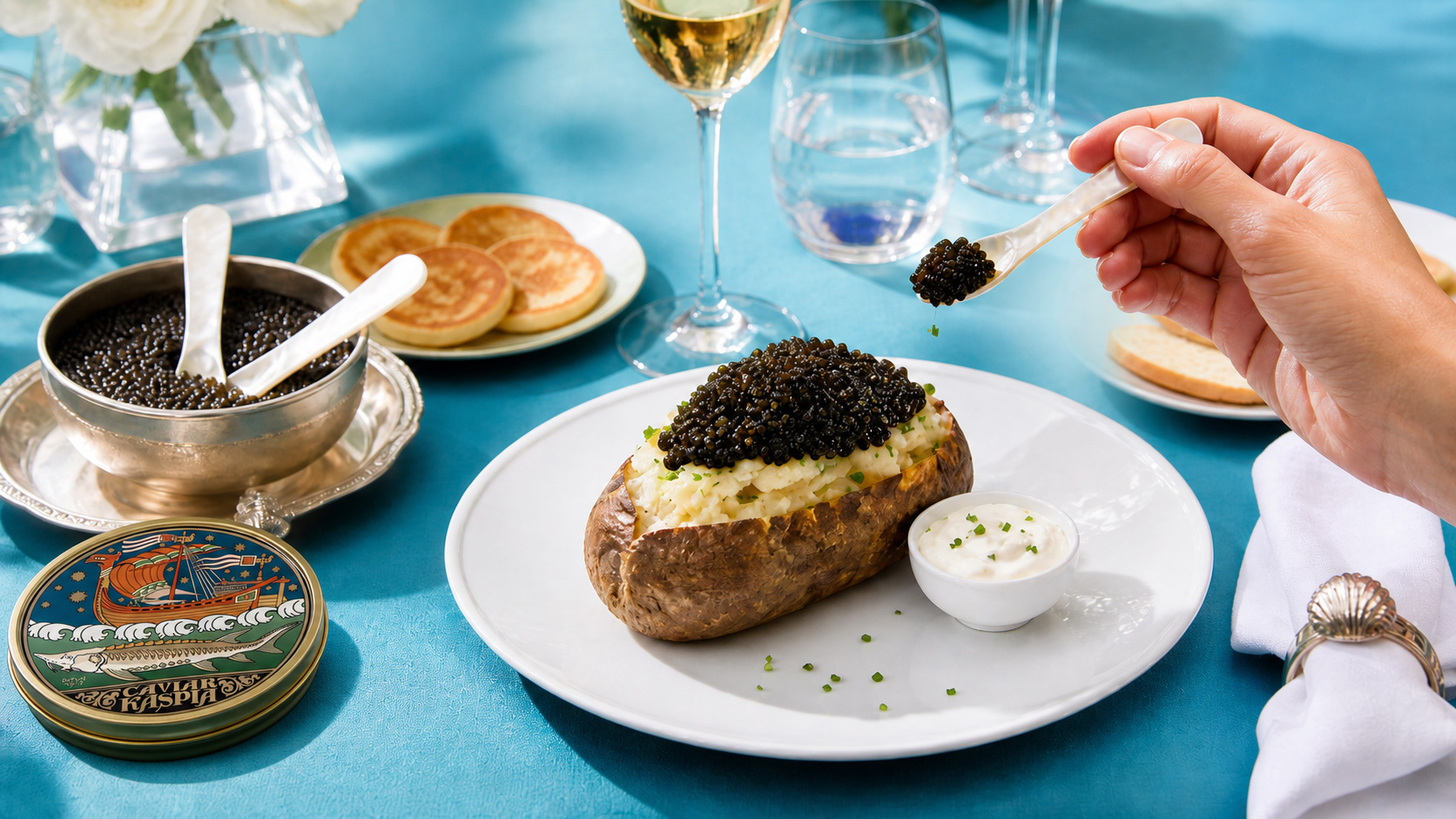
You've got the box. There it is, on the worktop, with its golden lid and that slight pressure when you run your thumb over the lid. Now what? Open it, stick a spoon in it, eat it - that's an option. But it's a bit like drinking a grand cru from a plastic cup. Caviar is at its best when given the right conditions. This guide shows you what they are.
What temperature should caviar be served at?
Between 8 and 10°C. This is the window in which aromas are released without texture degradation.
In practical terms: take the tin out of the fridge 15 minutes before serving. Not 30, not 5 - 15. Below 6°C, the grains congeal and you can only taste the salt. Above 12°C, the eggs soften and the taste becomes pasty.
A detail that restaurants know well: place the open can on a bed of crushed ice during service. Ice maintains the ideal temperature without lowering it too much. That's why caviar displays exist - they're not decorative, they're functional. The lower compartment holds the ice, while the tin rests on top. The caviar remains at the right temperature throughout the aperitif.
If you don't have a display stand, a bowl filled with crushed ice with the box in the center does the job.
The spoon: why metal is forbidden
This is the best-known and least respected rule. Metal - silver, stainless steel, aluminum - reacts with eggs. The result: a metallic aftertaste that pollutes the entire aromatic profile. You may not notice it on very salty caviar, but on Royal Osciètre or Beluga, it's a catastrophe.
Materials that work: mother-of-pearl, horn, wood, glass, bone. Mother-of-pearl is the standard because it's totally inert, soft in the mouth, and fine enough to pick up the beads without crushing them.
At Kaspia, the small mother-of-pearl spoon is designed for individual tasting - one bite, one gesture. Visit large engraved mother-of-pearl spoon is used for serving: it allows caviar to be placed on blinis or plates without damaging the grains.
What if you don't have mother-of-pearl or horn to hand? A plastic spoon is better than a silver one. It really is.
How to taste: the professionals' method
Before serving your guests, taste for yourself. Here's how the experts at the growers do it:
The back-of-hand method. Place half a spoonful of caviar on the back of your hand, between the thumb and forefinger. Bring to the mouth. The heat of the skin warms the grains very slightly - just enough for the aromas to unfold. This is the purest method because there is no intermediary between the caviar and your palate.
In the mouth. Do not chew. Roll the grains against the roof of your mouth with your tongue. The eggs burst out one by one. First the salinity, then the background notes - hazelnut for a Baeri, butter and nuts for a Osciètre, pure cream for a Beluga whale. Length in the mouth - what remains after swallowing - is what distinguishes a decent caviar from an exceptional one.
What to look out for. Grain size and regularity. Firmness (grains must be distinct, not clumpy). Color (homogeneous within the same tin). Smell on opening - good caviar smells of clean sea, never fish.
Classic accompaniments
Blinis and crème fraîche
This is the best-known pairing for a good reason: it works. The blini is neutral, slightly warm, with a soft texture that contrasts with the crunch of the grains. The crème fraîche softens the saltiness without masking the aromas.
Visit blinis Kaspia are thick and fluffy - reheat them for 2 minutes in the oven at 150°C, no more. If the blini is too hot, the seeds will melt on contact. For cocktails, the mini blinis are calibrated for a mouthful: a touch of cream, a spoonful of caviar, in the mouth.
Other possible toppings on the blini: soft butter (not salted), sour cream, or nothing at all if the caviar is excellent.
Potato
Underrated. A warm potato - in field dress, cut in half, slightly hollowed out - with a spoonful of caviar and a touch of crème fraîche. It's a Russian classic that Parisian restaurants are rediscovering. The warmth of the potato releases aromas just like the skin of a hand, but with more substance.
Soft-boiled egg
The pairing that surprises everyone. A warm soft-boiled egg, yolk still runny, crowned with a generous spoonful of caviar. The richness of the yolk and the salinity of the caviar meet - one of the most spectacular pairings in French gastronomy. And it costs almost nothing more than the caviar itself.
What to avoid
Lemon. It destroys the flavors and attacks the texture. Too much raw onion - a pinch of chopped onion may work, but beyond that, it takes over. Strong seasonings (pepper, chili, aromatic herbs) that overwhelm the caviar's finesse.
The simple rule: if the accompaniment tastes better than the caviar, it doesn't belong on the plate.
Beverage pairings
Champagne
The French classic. The bubbles cleanse the palate between mouthfuls, and the minerality of champagne extends the marine salinity of caviar. Choose a brut or extra-brut - demi-sec or rosé champagnes are too sweet and create a conflict on the palate.
A Champagne Brut Prestige makes an impeccable match. If you're entertaining and want to offer champagne and caviar together, the champagne and truffle set settles the matter in one fell swoop.
Iced vodka
The Russian classic. And for many connoisseurs, the best possible match - especially with a Beluga. Vodka doesn't compete with caviar's aromas. It frames them. Served between -18°C and -14°C, its texture becomes slightly syrupy and its neutrality allows the caviar to express itself without interference.
Visit Vodka Blanche Kaspia is distilled for this very purpose. To vary the pleasures, the Kaspia flavored vodkas - cherry, rose, bison - add a touch of color to the aperitif without distorting the accord.
Serve the vodka in small vodka glasses iced. The ritual is part of the pleasure.
Dry white wine
A Chablis premier cru, a mineral Sancerre, a Muscadet sur lie - dry, lively whites work well. Le Sancerre Sélection Kaspia is selected for this pairing. Avoid woody or overly aromatic whites (Gewurztraminer, Viognier) that compete with caviar.
What not to serve
Red wine. Tannins clash with iodine. Sweet cocktails. Beer (except a very dry lager in a pinch). Tea, coffee, fruit juice - anything that adds acidity or sugar.
How much to serve per person?
It depends on the context.
Pure tasting (aperitif) - 15 to 20 grams per person. That's 4 to 5 bites, enough to enjoy without breaking the budget. With a Caviar Baeri or a Imperial Baeri, This is the ideal size for an aperitif for 4 or 6.
Input - 20 to 30 grams per person. On a blini, potato or soft-boiled egg. This is the restaurant format.
As a main course - 30 to 50 grams per person. Rare, but memorable. It's time to open a Royal Osciètre or a Beluga Reserve and let caviar be the star of the meal, accompanied simply by blinis and crème fraîche.
Setting the table: caviar service
Order counts. Here's how to organize a service that works:
On the table: caviar display (or ice bowl) in the center. Warm blinis in a clean cloth to keep warm. Crème fraîche in a small ramekin. Mother-of-pearl spoons - one per guest if possible. Champagne or vodka glasses already served.
The opening. Open the box in front of your guests. This small gesture creates a moment - the marine scent that escapes, the color of the grains under the light. Caviar is a product for sharing, not something you prepare in the kitchen and bring ready on a plate.
Rhythm. Don't rush. Caviar is best enjoyed slowly. Each bite deserves 10 to 15 seconds in the mouth. Between bites, take a sip of champagne or vodka, or a piece of plain blini to reset the palate.
If you serve several varieties - Start with the mildest (Baeri), work your way up to the most complex (Osciètre), and finish with the most delicate (Beluga). It's the same logic as wine tasting: from the lightest to the most powerful.
Preserving leftovers
An opened tin can be stored for up to 48 hours in the refrigerator, between 0 and +4°C. Wrap the can in plastic film - the film should touch the surface of the beans to limit oxidation. Replace the lid on top.
Never transfer caviar to another container. The original tin is designed to preserve caviar - the metal is coated with a food-safe varnish that does not react with eggs.
And above all: never freeze caviar. Freezing shatters the grains. What remains after thawing looks like caviar, but has neither the texture nor the taste.
A final word of advice
Take the first bite plain. No blini, no cream, nothing. Just the caviar, on the back of your hand or on the mother-of-pearl spoon. This bite tells you everything: the freshness, the quality of the salting, the aromatic complexity, the length in the mouth. Everything else - the blinis, the champagne, the staging - is just more fun. But caviar alone must stand on its own.
If you don't know where to start, our Kaspia caviar collection covers all ranges, from Baeri initiation at Exceptional Iranian Beluga. And for service, the Kaspia accessories - mother-of-pearl spoons, display stands, vodka glasses - turn a tasting into a moment apart.

